March 2026 cohort in session

Where Today's Learners
Become Tomorrow's Automation Innovators.

Industrial robotics, machine vision & automation engineering — taught on real factory equipment in San Bernardino, CA.

A 501(c)(3) nonprofit closing the STEM opportunity gap by training the next generation of automation engineers.

AAI works alongside industry, education, and community partners to expand access to automation education for Inland Empire youth
FOR INDUSTRY & SPONSORS

Invest in the
Future Workforce

Support the next generation of automation talent through sponsorships, equipment partnerships, mentorship, and workforce development initiatives.

  • Sponsor student cohorts
  • Support certifications
  • Strengthen workforce pipelines
  • Community impact opportunities
Become a Partner
FOR DONORS & SUPPORTERS

Expand Access
to Opportunity

Your support helps students gain access to advanced technologies, industry-aligned instruction, and career pathways they might not otherwise experience.

  • Fund scholarships
  • Expand lab access
  • Support equipment acquisition
  • Increase student reach
Support AAI
The Opportunity

The robotics field is exploding.
The talent pipeline isn't.

The Inland Empire is one of the nation's largest logistics and manufacturing regions — yet many local students never get near the industrial robotics, machine vision, and automation systems reshaping that workforce. AAI exists to close that gap, giving students hands-on access to the same technologies powering modern industry.

$104.5K
Median salary, US industrial robotics engineer
100K+
Industrial robots sold in North America since 2022
88%
Businesses planning to adopt robotic automation
2.4M
Projected unfilled US manufacturing jobs by 2028
SACA Authorized Certification Center

Depth over volume.
Real hours on real equipment.

AAI's workforce-development model emphasizes depth of learning. Students progress through four hands-on automation tracks — industrial robotics, machine vision, additive manufacturing, and application engineering — accumulating up to 320 hours of practical experience.

20
Students Served
80
Module Completions
6,400
Student Learning Hours
320
Training Hours / Student
15
Students at MD&M West

As a SACA Authorized Certification Center, AAI connects hands-on technical training with industry-recognized credential pathways — helping students link what they build in the lab to future education and workforce opportunities.

From first day to career pathway.

01 Student Curiosity, no experience required
02 DAYP Training Hands-on, industry-aligned tracks
03 Industry-Aligned Skills Real equipment, real problems
04 Credentials & Education Credential pathways & next steps
05 Career Opportunities Into the regional workforce
A DAYP student speaking about her experience at Accessible Automation
REAL VOICES · DAYP 2025
In Their Words
"It's the coding part and the problem solving — figuring out how to make something work. That's what I keep coming back for."
DAYP Cohort 2025 Student
Inland Empire · Akoma Learning Center
Watch the full testimonial →
Support AAI

Help put industrial technology
into students' hands.

Your support removes financial barriers and gives Inland Empire students access to industrial robots, machine vision systems, engineering software, and career-connected learning they might not otherwise receive. Every contribution expands access to high-quality automation education.

501(c)(3) Nonprofit Serving Inland Empire Youth SACA Authorized Certification Center Industry-Aligned Curriculum
Discovering Automation Youth Program

Where students discover
their future in automation.

A free, intensive program for middle and high school students in Southern California's Inland Empire. Each 10-week cohort focuses on one of four tracks — industrial robotics, machine vision, additive manufacturing, or application engineering — taught by working engineers, on real equipment.

Student Level
Middle & High School
Training Tracks
4 Integrated Tracks
Track Duration
10 Weeks Each
Hands-On Training
Up to 320 Hours
Cohort Size
Max 20 Students
Access
No-Cost Participation
Curriculum & Equipment

The best way to prepare students for the future
is to let them build it.

AAI students train on the same industrial technologies used throughout modern manufacturing and automation environments. Using Epson industrial robots, machine vision systems, conveyors, pneumatics, and additive manufacturing tools, students gain hands-on experience building real automation solutions with professional-grade equipment and software.

Students work with both 4-axis SCARA robots for high-speed assembly applications and 6-axis articulated robots for advanced motion and automation tasks — developing workforce-ready skills through real-world technical training.

DAYP student in safety glasses standing beside an Epson SCARA robot cell with integrated vision system in the AAI lab, with additional Epson units visible in the background
DAYP LAB
A DAYP student presents her team's Epson SCARA cell — vision system, end-effector, and conveyor integrated and running.
Four Tracks · 320 Hours Total

One Integrated Automation Skillset.

From industrial robot programming and machine vision to additive manufacturing and automation engineering, DAYP students build 320 hours of hands-on experience using the same technologies powering modern industry.

TRACK 01

Industrial Robot Programming

Program Epson industrial robots used in modern manufacturing environments. Students learn motion control, coordinate systems, tooling integration, and production logic using both SCARA (4-axis) and articulated (6-axis) robot platforms.

  • Epson RC+ programming & simulation
  • Coordinate systems & tool calibration
  • Pick-and-place automation logic
  • Motion paths, timing, & production flow
10 WEEKS·80 HOURS·INDUSTRIAL ROBOTICS
TRACK 02

Machine Vision

Build machine vision sequences used for inspection, alignment, and automation guidance. Students configure industrial cameras, optimize lighting, and develop vision logic using real-world manufacturing scenarios.

  • Camera calibration & lighting techniques
  • Pattern matching, positioning, & inspection
  • Vision-guided automation concepts
  • Pass/fail logic & defect detection
10 WEEKS·80 HOURS·MACHINE VISION
TRACK 03

Additive Manufacturing

Design and manufacture real automation components using CAD and industrial 3D printing workflows. Students create tooling, fixtures, end-effectors, and custom automation parts used throughout DAYP projects.

  • CAD design & engineering workflows
  • Slicing, printing, & material selection
  • End-effectors, fixtures, & jigs
  • Functional automation part development
10 WEEKS·80 HOURS·DIGITAL FABRICATION
TRACK 04

Application Engineering

Integrate robotics, machine vision, sensors, pneumatics, and conveyors into a complete automation system designed to solve a real-world manufacturing challenge through team-based engineering and application discovery.

  • Automation cell integration
  • Sensors, conveyors, & pneumatics
  • Requirements gathering & application discovery
  • Team capstone automation project
10 WEEKS·80 HOURS·SYSTEM INTEGRATION
Track Progression

Each track builds on the last. Students leave with an integrated understanding of how a complete automation system comes together.

  1. 01 Industrial Robot Programming
  2. 02 Machine Vision
  3. 03 Additive Manufacturing
  4. 04 Application Engineering Capstone
Industry-Recognized Credentials

Students don't just learn the work.
They walk out certified to do it.

Accessible Automation Inc. is a member of the Smart Automation Certification Alliance (SACA) — the national body that develops and deploys Industry 4.0 certifications for the modern automation workforce. Students who complete DAYP tracks are eligible to earn SACA credentials that are recognized by employers, community colleges, and apprenticeship programs across the country.

Smart Automation Certification Alliance
Designated Authorized Certification Assessment Center
DAYP Tracks · SACA Certifications
TRACK 01

Industrial Robot Programming

  • C-102Certified Industry 4.0 Associate — Advanced Operations
  • C-103Certified Industry 4.0 Associate — Robot System Operations
TRACK 02

Machine Vision

  • C-362Machine Vision Systems 1
TRACK 03

Additive Manufacturing

Credential pathway in development.

TRACK 04

Application Engineering

  • C-215Robotic Operations 1
  • C-216Robotic Systems 1
  • C-312Robot Systems Integration 2
Student Work

Track 02 in action.

A DAYP student presents the coin-sorting machine vision system her team built — calibration, pattern matching, pass/fail logic. Real students. Real systems. Real outputs.

Machine Vision Capstone · Coin Sorter DAYP Track 02 · 2025 Cohort
1 min 28 sec
Real Voices

What students & parents
actually say.

Students and parents from the 2025 cohort talk about the program — what they learned, what surprised them, and why it mattered. No script, no edits to the message.

Student & Parent Testimonials DAYP · 2025 Cohort
4 min 14 sec
Industry Immersion

Beyond the classroom.
Onto the factory floor.

AAI students gain more than hands-on technical training — they gain direct exposure to the automation industry itself. At events like MD&M West, students interact with engineers, system integrators, and technology leaders while experiencing live industrial robotics and automation systems used throughout modern manufacturing.

DAYP cohort listening to an Automation Nth engineer explain an automated production line at MD&M West
MD&M WEST · AUTOMATION NTH

Full cohort tour of a high-speed packaging automation cell, walked through by the company's lead engineer.

DAYP students observing an Allen-Bradley Rockwell Automation production cell, one student filming with her phone
MD&M WEST · AUTOMATION NTH

One-on-one demos with Automation Nth's application engineers — featuring the same Epson industrial robot platforms students train on back at the AAI lab.

DAYP student in conversation with two Mecademic Industrial Robotics engineers at their MD&M West booth, with green Mecademic backdrop reading 'Enabling new microautomation possibilities'
MD&M WEST · MECADEMIC

A student questions Mecademic's engineers about their precision microautomation robots — the kind of direct industry conversation most high schoolers never get.

Outcomes

What students build beyond the classroom.

DAYP students gain more than technical knowledge — they develop hands-on experience, industry exposure, and the confidence to pursue futures in robotics, automation, and advanced manufacturing.

01 / SKILLS

Workforce-ready technical skills.

Students gain hands-on experience programming industrial robots, configuring machine vision systems, integrating automation equipment, and developing real-world automation solutions using industry-grade technology.

Eligible DAYP tracks support pathways toward industry-recognized SACA credentials.
02 / EXPOSURE

Direct access to industry.

Through mentorship, industry partnerships, and experiences like MD&M West, students engage directly with engineers, automation professionals, and advanced manufacturing technologies — expanding awareness of careers, college pathways, and future opportunities.

03 / CONFIDENCE

Confidence through real experience.

Students leave knowing they belong in technical spaces because they've already worked with the tools, systems, and problem-solving processes used throughout modern automation and advanced manufacturing industries.

Know a student who'd thrive here?

The next cohort is filling now. Reach out — we'll walk you through eligibility and enrollment.

SUMMER 2026 · COHORT 04

Industrial Robotics &
Machine Vision Summer Intensive.

A one-week, 30-hour technical program where students train on the same industrial robots and vision systems used on real manufacturing floors — not laptops, not toys.

Early-bird enrollment is open — limited to 12 seats per cohort
Duration
5 days / 30 hrs
Cohort size
12 max
Ages
12–18
Format
70% hands-on
01 / Differentiation

Not your typical STEM camp.

Most summer programs hand students a laptop and a curriculum from a textbook. We hand them an industrial robot and a problem from the factory floor.

Capability
Typical STEM Camp
AAI Intensive This program
Industrial-grade equipment
Educational kits & toys
Epson industrial robots
Machine vision systems
Not included
Real inspection cameras
Time spent hands-on
~30% lab
70% lab, 30% lecture
Curriculum source
Generic STEM material
Industry-aligned
Career exposure
Limited
Real automation roles
Cohort size
25–40 students
12 students, max
02 / Curriculum

What students actually do.

Four core competencies, taught the way they're used in production environments — by writing code, calibrating hardware, and shipping working systems.

/ 01

Program an industrial robot

Write motion paths, set up tooling, and run pick-and-place cycles on Epson SCARA (4-axis) and articulated (6-axis) arms.

EPSON RC+ 6 hrs
/ 02

Build a vision inspection rig

Calibrate cameras, write inspection logic, and detect defects on a moving line.

VISION 8 hrs
/ 03

Run an automation cell

Integrate robot + vision + sensors to complete a real-world manufacturing task end-to-end.

INTEGRATION 10 hrs
/ 04

Solve an engineering challenge

Final-day capstone: teams diagnose, redesign, and demo a working automation solution.

CAPSTONE 6 hrs
03 / Spec Sheet

Program details.

A focused, full-week intensive. Built like a short professional training, not a summer-long camp.

Three students working hands-on with an Epson industrial robot cell at the AAI lab — one programming at the workstation while another positions a part at the robot's end-effector
AAI LAB
Duration
1 week (5 days)July or August · dates announced quarterly
Daily schedule
6 hours / day · 30 hours total9:00 AM – 3:30 PM, lunch included
Format
30% lecture · 70% hands-on labTwo students per workstation, max
Cohort size
12 students (limited)Application-based, ages 12–18
Location
Inland Empire, CAAddress provided after enrollment
Take-home
Certificate · portfolio video · letter of completion
04 / Outcomes

Where students land.

Five days is enough time to move from "interested in STEM" to "has built something real with industrial equipment."

Day 0 · Entry

Interested in STEM

Curious, capable, looking for a real challenge.

  • General curiosity in engineering
  • Some coding or robotics exposure
  • No industrial-equipment experience
  • Unclear on real career paths
Day 5 · Exit

Hands-on automation engineer mindset

Built, debugged, and demoed real systems.

  • Programmed SCARA & 6-axis industrial robots
  • Calibrated a machine vision pipeline
  • Shipped a working capstone automation cell
  • Met automation engineers and seen the field
05 / Tuition

Tuition & sponsorship.

As a 501(c)(3) nonprofit, every paid seat helps fund a sponsored seat for a student who couldn't otherwise attend.

Standard

Full Tuition

$750

Full week · all materials · lunch included

  • 30 hours of instruction
  • Equipment & consumables
  • Certificate of completion
Enroll at standard
Need-Based

Sponsored Seat

$0

Funded by paid enrollments & donor contributions

  • Same program, no cost
  • Brief application required
  • Decisions within 7 days
Apply for sponsorship
06 / Trust

Built with industry,
for students.

Curriculum reviewed by working automation engineers. Operated by a registered nonprofit.

"My son came home talking about cycle times and vision tolerances. He didn't just play with a robot — he programmed one. That's what I wanted."

MR
Maria R.
Parent · Cohort 02 · Riverside

"We were comparing this to a university summer program at twice the price. The equipment list alone made the decision. Real industrial gear, real engineers."

DK
David K.
Parent · Cohort 03 · Ontario
Registered 501(c)(3) U.S. nonprofit · tuition is tax-deductible
Industry-aligned curriculum Reviewed by working automation engineers
Inland Empire focused Local employers · local students · local impact
ENROLLMENT OPEN · COHORT 04

Give your student a head start in the
future of technology.

Twelve seats. One week. The same equipment used to build the world around us. Reserve a seat or request a full info packet.

Launching Soon

Adult Workforce
Development Training.

Industrial robotics certification for working professionals and adult learners (18+) ready to pivot into the high-demand world of automation.

Get Notified When We Launch

Certification track

Practical, employer-recognized credentials in industrial robotics programming.

Built around working schedules

Evening and weekend cohorts designed for adults already in the workforce.

Direct employer pipeline

Partner companies actively recruiting graduates for open robotics roles.

Affordable pathways

Sliding-scale and sponsored options for qualifying applicants.

Launching Soon

Educational Curriculum
for Schools.

License our industry-aligned automation curriculum for your high school, community college, or workforce program — taught the way industry actually works.

Request More Information

Industry-aligned

Built and taught by a 20-year application engineer — reflects what employers actually need.

Project-based

20 hands-on sessions per module, structured around real automation challenges.

Educator support

Train-the-trainer onboarding and ongoing instructional support for licensing partners.

Equipment guidance

We help your institution source and configure the right robotics lab for your students.

Partner With Us

Build the workforce
you actually need.

Whether you're a corporation looking to invest in CSR with measurable outcomes, an industry partner with equipment to contribute, or an individual who wants to change one student's trajectory — there's a way to plug in.

501(C)(3) NONPROFIT
All gifts are
tax deductible.
EIN · 93-1438683
You'd be joining these industry & education partners
For Individuals

Your dollars go straight to students.

Concrete impact, no overhead games. Every gift is tracked back to actual program delivery — instruction, equipment, and student support.

Donate Now
For Corporations

Five sponsorship tiers.
One workforce strategy.

Each tier maps to a concrete, measurable program outcome — so your CSR investment delivers visible impact, not vague sentiment.

Advocate
$1,000
Sponsor one student through a 10-week module — equipment, materials, instruction.
  • Donor listing recognition
  • Thank-you certificate
  • Student progress update
  • Optional virtual classroom visit
Supporter
$3,500
Support one student through a full 40-week program — all four modules.
  • All Advocate benefits
  • Logo on partner wall & student gear
  • Partnership certificate + CSR media kit
  • Student showcase invitation
Empowerment
$17,500
Sponsors one full 10-week module for the entire cohort.
  • All Discovery benefits
  • Module sponsor recognition
  • Prominent classroom & website logo
  • Guest lecture, site tour, or mentorship
Innovation
$65,000
Fully funds a 40-week cohort of 20 students — all modules, instruction, and resources.
  • All Empowerment benefits
  • Naming rights for the cohort or lab
  • Executive speaking role at showcase
  • Up to 5 employee mentor invitations
  • Full feature in Annual Impact Report
Beyond Funding

Three more ways
to partner with us.

A complete workforce pipeline isn't built on dollars alone. We work with industry partners on equipment, mentorship, and curriculum — and we'd love to add you to that list.

In-Kind Equipment

Donate tools, robots, software, or materials. Students train on the same gear your engineers use — building familiarity with your technology ecosystem.

Talent & Mentorship

Send your engineers to mentor, lead workshops, judge capstones. Your team builds purpose-driven engagement; students get exposure to real careers.

Curriculum Co-Development

Help us shape what students learn next. Co-develop curriculum and use cases that align talent development directly to your workforce needs.

Next Step

Schedule a partnership conversation.

Tell us about your goals, your workforce, and your CSR priorities — we'll show you exactly how a partnership could look.

About Accessible Automation

Making automation accessible isn't a tagline.
It's the whole point.

A 501(c)(3) nonprofit closing the STEM opportunity gap — bridging the skills divide between underserved students and the automation industry that needs them.

Our Story

Why Accessible Automation exists.

Automation runs modern industry — yet the companies building it can't find enough skilled people to keep up. The technology is advancing far faster than the talent pipeline feeding it.

At the same time, the students who could fill that gap rarely get near it. In underserved communities especially, industrial robots, machine vision, and advanced manufacturing aren't part of the conversation — not because the interest isn't there, but because the access never was.

AAI exists to close that distance. We put real industrial technology in students' hands and turn curiosity into a credible path toward a technical career — for the young people most often left outside the room.

Our Mission

Empowering today's minds to become tomorrow's innovators.

Accessible Automation Inc. is a 501(c)(3) nonprofit dedicated to bridging the STEM skills gap by providing industry-aligned education and exposure to automation, robotics, and advanced manufacturing.

We believe automation should democratize opportunity — not restrict it. Through mentorship, hands-on learning, and a forward-thinking curriculum, we empower the next generation to transform challenges into opportunities.

Our students aren't just being prepared for the future of automation. They're going to build it.

Our Vision

A future where innovation knows no boundaries.

We envision a global community united by innovation and opportunity, where the transformative benefits of automation — economic growth, social equity, environmental responsibility — are shared by all.

We're working toward an industry where diversity drives progress. Where a kid from San Bernardino can stand alongside graduates from any school in the country and know they belong.

The Story Behind AAI

Built from industry.
Designed for students.

Accessible Automation Inc. was founded on a simple belief: every student deserves access to the technologies shaping the future. What began as one engineer's response to a growing workforce challenge has become a nonprofit dedicated to expanding opportunity through hands-on automation education.

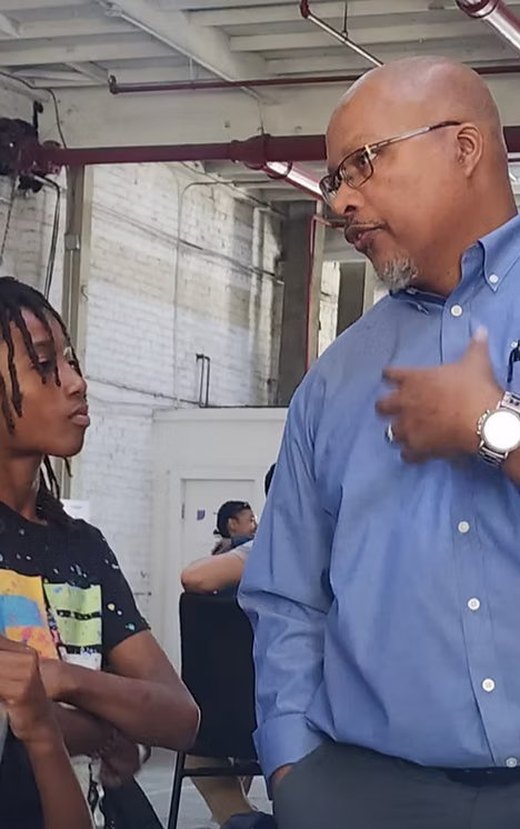
AAI founder Isaac Nash-Bey speaking with a student in the lab

Isaac Nash-Bey

Founder & Executive Director

AAI grew out of a problem its founder saw firsthand. After more than 20 years designing industrial automation systems, Isaac Nash-Bey watched the field advance faster than the talent pipeline feeding it — while the students who could fill that gap, particularly in underserved communities, rarely got near the technology at all.

AAI was created to close that distance. The organization puts industrial robots, machine vision, and additive manufacturing directly in students' hands, helping them build technical skills, discover career pathways, and gain exposure to the same systems powering modern manufacturing. Isaac's industry background shapes how that work gets done — and keeps it grounded in what employers actually need.

What We Believe

The principles that guide our work.

Access Creates Opportunity

Students deserve access to industry technology regardless of background or income. Opportunity shouldn't depend on a zip code.

Learning Happens by Doing

Hands-on experience with real equipment builds the confidence, skills, and curiosity that lectures alone never can.

Technology Should Be Inclusive

The future workforce should reflect the communities it serves — and that starts with who gets to participate today.

Connected to Industry

Working alongside organizations that open doors.

We work alongside organizations that help connect students to education, industry, and opportunity.

Looking Ahead

Where we're headed.

We're working to reach more students, expand access to industrial technology, and build clearer pathways from the classroom to industry-recognized credentials and real careers. The goal is steady and simple: a stronger pipeline of skilled, confident young people ready to help build the future of automation — and an industry that's better because they're in it.

Want to be part of this?

Reach out — we'll show you the work.

Contact

Let's start a conversation.

Tell us a little about why you're reaching out and we'll route your message to the right person.

Get in touch directly.

Phone
(909) 343-2017
General Inquiries
info@accessible-automation.org
Donations
donations@accessible-automation.org
Mailing Address
PO Box 9727
San Bernardino, CA 92427
Tax ID
EIN 93-1438683 · 501(c)(3)